Thursday, November 19, 2015

Daily Thoughts 11/19/2015

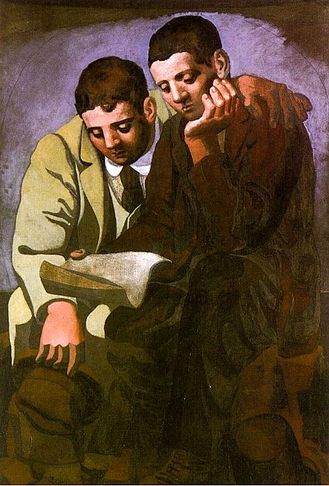
Reading The Letter - Pablo Picasso
Reading the Letter, Pablo Picasso, 1921

Daily Thoughts 11/19/2015

I have been reading Riders of the Purple Sage by Zane Grey.


I checked the library Twitter and Facebook.

I checked the displays and the gift books.

I also spent some time working on programming.

I am writing the final report for the Latino Americans 500 Years of History Grant tonight.  I will probably finish it tomorrow.

A colleague is showing the film, On Two Fronts, Latinos and Vietnam which is a PBS documentary on Monday, November 23, 2015 from 4:00 p.m. to 5:30 p.m..

I have also been going over some more ideas about the computer lab and the public computers here.

Web Bits


2015 National Book Award Winners Announced

As Vote Nears No Consensus on Brooklyn Heights Library Development

Wednesday, November 18, 2015

Daily Thoughts 11/18/2015

The Art of Drawing - Eugène Grasset
The Art of Drawing, Eugene Grasset, 1894

Daily Thoughts 11/18/2015

I checked the library Twitter and Facebook this morning.

I read the New York Daily News and the New York Times on the train to work.  It is a little old fashioned, but I like doing it sometimes.

I checked the gift books and the displays.

I also spent a litttle time on programming.  It is mainly plays, concerts, and films for February and March which I am working on.

I spent some time reading the latest New York Review of Books and the Times Literary Supplement.

I cheked out a paperback copy which is a two in one western of Riders of the Purple Sage and The Rainbow Trail by Zane Grey.  I also checked out Creating A Learning Society by Joseph Stiglitz and Bruce C. Greenwalk.  Columbia University houses Joseph Stiglitz's papers.  http://library.columbia.edu/news/libraries/2012/20121009_stiglitz.html

Web Bits

An Opulent Bronx Library In Decay, and in Search of a Purpose
http://www.nytimes.com/2015/11/19/nyregion/an-opulent-bronx-library-in-decay-and-in-search-of-a-purpose.html?_r=0

Exclusive: Brooklyn Public Library Deal Falls Short of Market Value, Leaves City Short Changed
http://www.nydailynews.com/new-york/brooklyn/brooklyn-public-library-deal-leaves-nyc-shortchanged-report-article-1.2438695

Tuesday, November 17, 2015

Daily Thoughts 11/17/2015


Ainola Museum Oulu pre 1929.jpg
A postcard of Ainola museum and library. It was designed by Swedish architect J. E. Stenberg and completed in 1888. Building was destroyed in a fire in 1929.

Daily Thoughts 11/17/2015

I checked the library Twitter and Facebook this morning.

On the way to work, I read some of The World Brain by H.G. Wells.  It is an argument for a universal encyclopedia so that intellectuals and knowledge workers will have more influence.

I checked the displays and the gift books.

Better World Books came by to pick up their shipment.

There are two computer classes tonight.  A Fundamentals of Computers class and Beginning Microsoft Word class.

I finished reading The World Brain on the way home.  H.G. Wells describes a universal encyclopedia.  He imagines that photographic images will be so reduced that they could be stored easily, a microscopic library of record.  This way every person at their study could have access to almost any book or image.  Part of this imagination is a kind of universalization of learning.  There would be a single worldwide organization which would manage the content of the encyclopedia.  Creating a common set of ideas would help combat war.  The content is very utopian.

This book very much reminds me of Wikipedia in its idealism.

Web Bits

Defining Diversity in Libraries

Sunday, November 15, 2015

Daily Thoughts 11/16/2015

File:Galactic-library-glyph-Uplift.svg

 One visual interpretation of the Galactic Library glyph (Library Institute emblem), based on the verbal descriptions in David Brin's "Uplift" series of science-fiction novels (a five-fold spiral with a vertical bar through its center).

Daily Thoughts 11/16/2015

I checked the library Twitter and Facebook this morning.


Last night, I finished reading The Islands of the Blessed by Nancy Farmer.  I enjoyed reading this title.  It is the third book in the story of Jack the apprentice bard trilogy.  I rather like how Nancy Farmer seemlessly mixes, history, myth and fantasy into her stories.

I checked the gift books and the displays this morning.

I interviewed a few people today with a colleague.

I am spending some time talking to people about the public computers and the computer lab policies.

On the way home, I finished reading Superforecasting The Art and Science of Prediction by Philip Tetlock and Dan Gardner.  This book is focused on the Good Judgement Project https://www.gjopen.com/.  It is about how to improve your accuracy in making predictions about the future.  The main focus is geopolitical in nature.  A lot of this book focuses on how to follow the news, keep track of ideas, understand statistics, take inside and outside views, and be open minded about what might possibly happen. A lot of the book is about how to ask the right questions and consistently do the research.

Web Bits


Beneath New York Public Library, Shelving Its Past for High-Tech Research Stacks

Check It Out With Andrew Richard Albanese: How the Google Books Case Could Change Fair Use on Campus


The World Brain

One of the things which happens when most of the books are scanned into a single source is that it improves the map of knowledge created by the web of information on the internet.  This web of information is what Google calls the Knowledge Graph.
Google Launches Knowledge Graph to Provide Answers Not Just Links.
http://searchengineland.com/google-launches-knowledge-graph-121585

Another way to look at the knowledge graph which I think of as the interrelations and connections between different types of knowledge is to compare it to the social graph.  The social graph is the total map of interrelations and connections between people on the internet.
https://en.wikipedia.org/wiki/Social_graph

Startup Unleashes Its Clone of Google's Knowledge Graph
http://www.wired.com/2015/06/startup-shares-google-knowledge-graph-clone-everyone/

This does not just apply to Google, it also applies to places like the Internet Archive which has massive amounts of all kinds of items scanned into it.  This is an example of a data set with 1 million album covers. Experiment with 1 Million Album Covers.
https://blog.archive.org/2015/05/27/experiment-with-one-million-album-covers/


Mass scanning also allows the study of the total content of all the books put into Google.  This creates something called Culturomics which is a way to do mass text analysis of language.
http://www.culturomics.org/home

It is not just Google books that is doing this kind of research.  It is the Hathitrust which is another archive with mass scanning of books.
https://www.hathitrust.org/htrc

There are two other organizations focused on creating universal access to information, Wikipedia and the Internet Archive which seem to have a goal of absorbing most knowledge.

On the fictional side, Isaac Asimov made his first reference to the Encyclopedia Galactica  in his short story, Foundation written in May of 1942.

There is also the Galactic Library in the Uplift novels of David Brin.  The first novel was written in 1980 called Sundiver. 

On a lighter note, there is also The Hitchhiker's Guide to the Galaxy by Douglas Adams.

Daily Thoughts 11/15/2015


Daily Thoughts 11/15/2015

I checked the library Twitter and Facebook this morning.


The World Brain

There were other attempts to create a universal library before the internet.  Vannevar Bush who came up with the idea of hypertext suggested a machine called a Memex could be built.


One of the articles Vannevar Bush is famous for is "As We May Think."


The legal issue with scanning books by Google has ended.  This means the scanning part can continue.

Google's Book Scanning Project Is Legal, U.S. Appeals Court Says

The second part which is the building of algorithms and artificial intelligence to search books by Google has also changed.  Recently Google made its machine learning code open source.  Microsoft soon followed suit.


Microsoft Open Sources Machine Learning Toolkit Less Than A Week After Google

Algorithms are already being used to make book recommendations.  Amazon does this with its bookselling.  Amazon also owns Goodreads.

This is a comparison article between librarians recommendations and Goodread recommendations.
What Book Should You Read Next? Putting Librarians and Algorithms to the Test

Amazon recently opened a bookstore.  They are using shelf cards to describe each book as well as the recommendation algorithms to choose which books go into their new store.


When is a Bookstore Not a Bookstore, A Librarian's Take on the Amazon Store